For organisations 3 of 3
- Why it fails
- Poor leadership hides in plain sight
- Right money, wrong people
Are you investing in the right leaders?
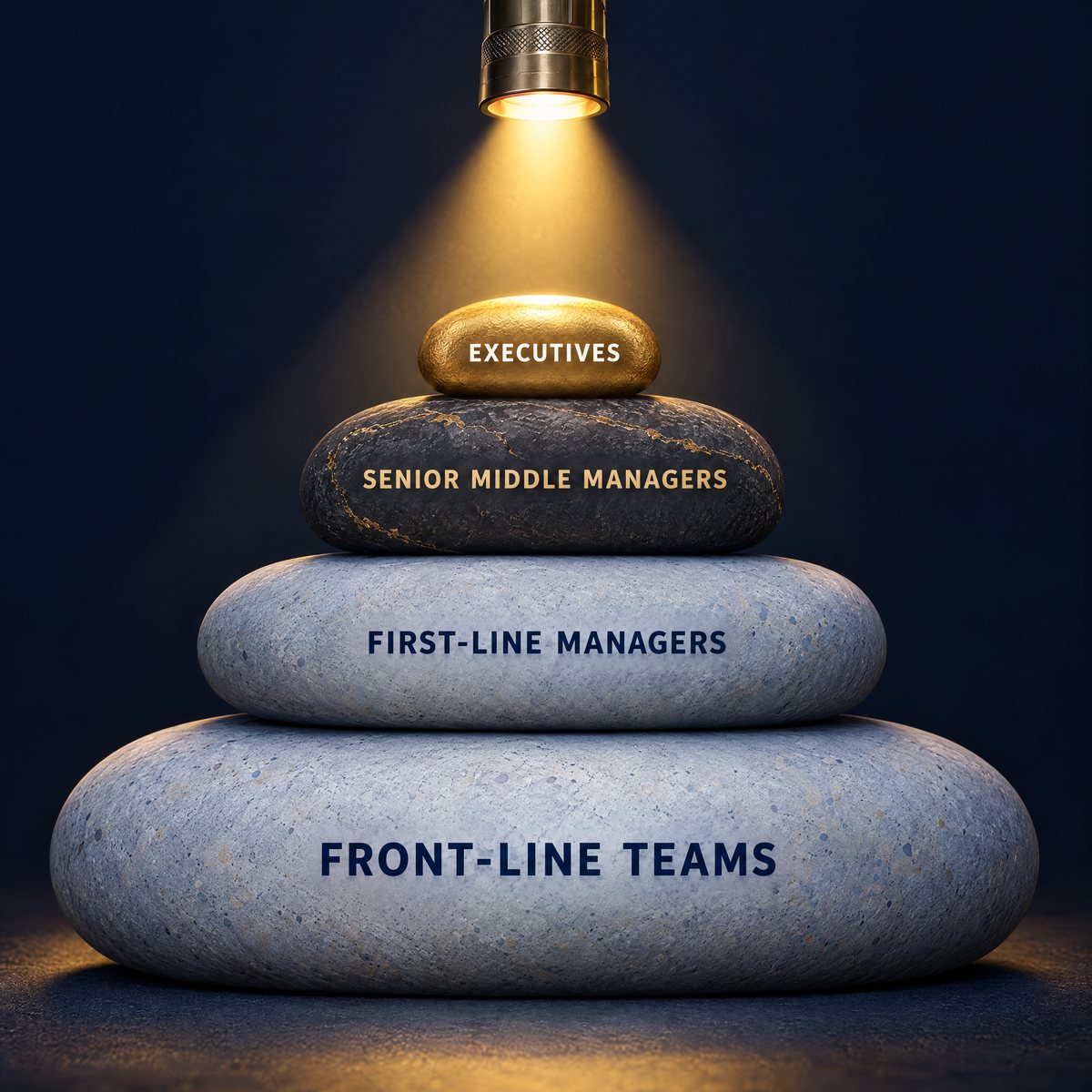
In multi-tiered leadership organisations, much of the development money is ring-fenced for the most senior people, and it is often spent at the point of promotion, which is the point at which a person is least willing to change.
Organisations develop the wrong people, at the wrong time
The language changes too, from training to coaching. What does not change is the target. A newly promoted leader is visible in a way they have never been, to their people, to HR, to the board, and their management want them to look the part. So the development is tactical. Present better. Communicate better. Look more confident. Every one of those is about how they are seen.
The money is being spent on making the mask more convincing.
It rarely gets argued the other way. Weight the investment towards your senior middle managers, and you are building a pipeline of executives with the culture and the mindset the organisation will actually need in ten years.
Why target that layer, specifically
Senior middle managers are where people stop managing and start leading. Strategic enough to matter, still close enough to the work to see it. They lead the first-line managers and they report to the executives, so they are the only layer touching both the people who do the work and the people who decide. Yet it is the layer that gets neglected.
Gallup’s 2015 research puts at least seventy per cent of the variance in team engagement, across business units, down to the manager. Change the leaders of leaders, and you change the daily experience of the largest population of employees you have.
Executives are not indifferent to culture. They are just further from it than they think. PwC’s 2021 Global Culture Survey found that seventy-seven per cent of senior management feel a personal connection to the company's purpose, against fifty-four per cent for the rest of the workforce. What is decided at the top has to survive the journey down, and every route down runs through your senior middle managers.
Feel a personal connection to the company’s purpose
Culture does not change by executive diktat.
It changes with who becomes an executive.
Those executives come from your senior middle managers. If enough capable people reach executive level already grounded, low on ego, and developed to serve the people they lead, the gap closes. Not because anyone announced a value, but because the people who rise are not the same people.
Most succession planning asks whether a person is ready for the job. The better questions are how they will behave once they have it, and whether they bring what the organisation will need in future, not only what it needs today.
One leader raised differently changes the managers beneath them, and those managers change everyone else.
For founders and investor-backed companies
Drinking from a fire hose
A fast-growing company is different from an established business. Whether it is backed by venture capital, private equity or its founders, there is often no leadership structure in place yet. Your leadership is the founder and the handful of people promoted quickly because the business grew quickly, and their habits become your culture before anyone has written it down.
Your company can only grow as fast as its leaders do.
So the people to develop are the ones already at the top, and the time to do it is before the next stage of growth exposes the gaps, not after.
If the pressure is in the sales team, see Sales Leadership Advisory →

What you get back
Change that transfers to the job. The behaviour holds under pressure because the belief underneath it moved, not because a technique was learned in a room and practised for a fortnight.
Teams that re-engage. A leader who stops performing gives that energy back to the people who work for them, and they register it before they could tell you why.
Executives who arrive already grounded. Low on ego, and developed to serve the people they lead. Nobody will have to announce the culture to them.
In a fast-growing company, founders and early leaders, who are there at the inception, are forced to keep pace with the business’s acceleration. Developing them early gives them the skills and knowledge to deliver their targets.
That is the return. Not a better score against a framework, but rather a group of leaders you would choose again.
What the programme is not
The programme is not a workshop, and it is not a competency framework. It is not therapy, and it is not diagnosis. Most importantly, it is not for everyone. This work cannot be forced on a person. It has to be their choice. It is likely the first time they will have come face to face with their truth, and some people find that too difficult.
The honest constraint. I work with a small number of people at a time, because the work is close and it does not scale by dilution. That shapes what I can take on, and it is worth saying before we talk rather than after.
One thing before you write to me
This only works if the person wants it. If they are being sent and they are reluctant, it will fail, and I would rather tell you that than take the work. If they want it, write to me and tell me who they are and what you have already tried.
If you would rather I spoke to them first, explained what the programme involves and gave you my view on whether they are suitable, I am open to that.
Or write to me at richard@gain-intelligence.com